


A Lot Can Change In A Summer
In 2020, I wrote about the re-emergence of the Environment Bill after a General Election and said that slow burning changes in how we value natural resources are going to reshape how we plan, design and deliver development. In this series of articles, I explore how far we have come since; in implementing natural capital and ecosystem services accounting in the planning system – starting with the impact of the coming Nature Restoration Levy.
This first piece considers the machinery of Environmental Delivery Plans (EDPs). The next pieces look at the price of using it and what the Levy does – and does not – buy those investing in development.
It’s Here
The Starmer Government emphasised the need to deliver nature recovery at scale and move development from a process to an outcomes focus. The core objectives underlying the Development and Nature Recovery elements of the Planning and Infrastructure Act 2025 were:
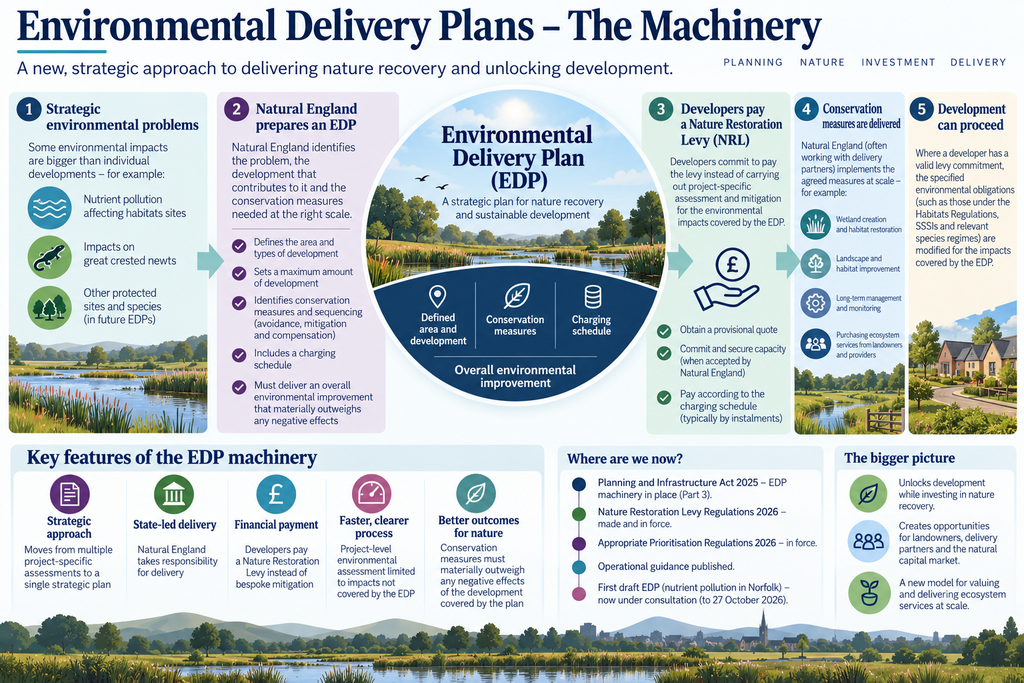
- moving from multiple project-specific assessments to a single strategic assessment and delivery plan (operating strategically).
- making the state responsible for delivery
- allowing specified impacts to be dealt with strategically in exchange for a financial payment that helps fund strategic actions, so development can proceed more quickly. Project-level assessment and mitigation under the relevant environmental regime are meant to be limited to impacts not covered by the EDP.
No More Gardening In Isolation?
The Nature Restoration Fund (NRF) model is intended to allow Natural England to identify:
- strategic challenges and the development that contributes to them;
- conservation measures – at an appropriate scale that can solve them;
- a Nature Restoration Levy (NRL) to pay for them.
An EDP is – largely – intended to be an optional alternative to meeting project-by-project needs without the project-level mitigation or offsetting. They may – exceptionally – be used to make the NRL mandatory for specific development and environmental impacts.
A Busy Few Months
The Government has moved swiftly to set up the new regime, introducing an array of new law and guidance during the first part of 2026:
- The Nature Restoration Levy Regulations 2026 were made on 10 September (in force on 11 September 2026);
- The Environmental Delivery Plans (Appropriate Prioritisation) Regulations 2026 came into force on 9 July 2026. They require Natural England to consider avoidance, mitigation and compensation – in that order – where it considers that appropriate, while also allowing expert judgment about the most effective strategic response to environmental issues;
- Government and Natural England published developer and implementation guidance on 1 September, including how developers will obtain NRF quotes, reserve capacity and commit to the Levy;
- On 17 September Natural England opened consultation on the first draft EDP, dealing with nutrient pollution in Norfolk. Government also published statutory guidance on the overall improvement test and on how Natural England should secure the conservation measures that EDPs will fund.
Environmental Delivery Plans – Why?
An EDP is a plan for delivering conservation measures whose effects must “materially outweigh the negative effect of the EDP development” – assessed against the maximum development the plan can cover. The SoS may make an EDP only if she considers that it passes this statutory overall improvement test.
This is not just an offsetting regime. An EDP may contain avoidance, mitigation and compensation measures, but at plan-level the statutory requirement is stronger than equivalence: the positive effects must materially outweigh the negative effects.
What is difficult to pin down is that classic exercise of planning judgement in weighing how one set of effects balance against another.
An EDP must define:
- the area (and types of development) it covers, the maximum amount of development that can rely on it, the environmental features/ impacts it addresses
- the intended conservation measures and their sequencing;
- the charging schedule; and
- how the package produces an ‘overall environmental improvement’.
- Once a developer commits to the Levy, it is also the statutory basis on which specified environmental obligations are discharged, disapplied or modified for the covered impact.
Capacity
Developers can reserve EDP capacity to address a specified environmental impact that would otherwise have to be dealt with through the existing project-specific regime. The Developer Guidance makes clear that provisional quotes do not reserve EDP capacity: it is allocated only when Natural England accepts the request to use the Levy and issues a commitment certificate.
This commitment has a six-month shelf life if no planning application is made. If an application is submitted in time, there is no equivalent six-month determination deadline; but the commitment can later be cancelled on specified grounds, including if the only planning permission expires without implementation.
In a heavily-constrained EDP area, the commercially pointy end will arrive quickly. How many developers will buy land or progress with options in reliance on the EDP route rather than buying or delivering their own solutions with greater commercial flexibility?
The New Market
The BNG regime and nutrient woes have already created a dynamic natural capital market remarkably quickly. The market is matching landowners, developers, contractors and arrangers. How these players interact with the new system will be important to its success in moving from project-mitigation to strategic outcomes.
Natural England is tasked – in effect – with administering a functioning market for the nature services specified in the EDPs. The new statutory guidance on securing conservation measures is clear that the regime should:
- aggregate developer payments to create ‘sustained and quantified demand’ for nature services;
- support the growth of nature-services markets and the supplier base.
Those suppliers include landowners/land managers, habitat banks, environmental NGOs and ecological consultancies.
The guidance marks the advent of procurement rules, in effect, for suppliers – it emphasises:
- ‘fair and open competition’ as the preferred route;
- aligning with relevant BSI Nature Investment Standards where appropriate;
- taking a “test and learn” approach as the market develops.
The New Natural (England)
Natural England has now become
- the identifier of environmental challenges to development
- an aggregator of developer demand
- a strategic purchaser of ecosystem services.
This is fairly labour intensive. No surprise, then, that it has announced a more strategic approach to planning advice. On 1 October it published an Operational Statement signalling greater use of standing advice and early strategic engagement, with bespoke input focused on the most complex and high-impact cases.
These changes should create opportunities for larger, properly planned interventions at a scale that works for nature and a more predictable market for nature recovery. They do raise practical questions about procurement, conservation covenants, S106 agreements, long-term maintenance, monitoring and who carries the delivery risk, though.
Although Natural England’s statutory consultee status is unchanged, its role is slightly different – its Operational Statement reflects greater flexibility over wider project-specific advice[1]. The assumption that this switch to a more strategic role will work, in timing terms, with an ongoing pipeline of projects requiring project-specific views on issues not covered by EDPs is going to be tested.
First Test
The legal machinery is now in place, but the developer route is not yet live until an EDP is made. The first draft EDP – the Norfolk nutrient-pollution EDP is open for consultation until 27 October 2026 and I pick the issues arising up in the next piece.
The ultimate test of any discretionary system is whether it is quicker, simpler and used. Owners, investors and providers of ecosystem services can now see the intended shape of the market – and feed back on how it will work in practice.
[1] Note that the Planning and Infrastructure Act 2025 amended section 4 of the NERC Act 2006 so that NE no longer has to provide advice in response to every public-authority development-related request.