

My previous article described how the P&IA 2025 is creating a new strategic planning architecture. This one considers how the Government’s review of Local Government Reorganisation (LGR) affects who may exercise some of the new powers.
Mayors and Unitaries – Watch This Space
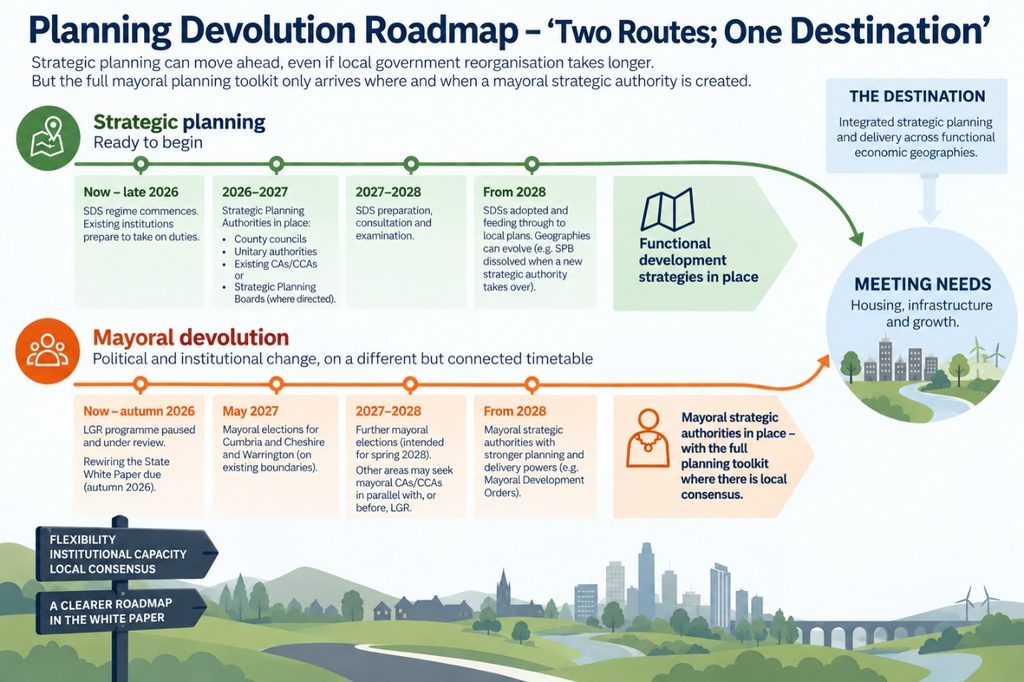
On 7 September 2026, the Government paused (and put under review) most of the LGR programme:
- Decisions for Greater Essex, Hampshire and the Solent, Norfolk and Suffolk were withdrawn;
- The July 2026 LGR decisions (and the outstanding Cambridgeshire and Peterborough and West Sussex structures) are being reviewed;
- May 2027 elections will now take place on existing boundaries.
The sequence set out in the Government’s 4 December 2025 Devolution Priority Programme update envisaged new mayors exercising new strategic planning powers over newly-minted unitary structures. The target for inaugural mayoral elections in May 2028 in the four Devolution Priority Programme areas – Greater Essex, Hampshire and the Solent, Norfolk and Suffolk, and Sussex and Brighton – was expressly tied to completing LGR first.
The 7 September announcement is not a retreat from devolution – it is clear that local government structures remain key to the Government’s devolution ambitions and to ‘filling the map’. The scale and pace of LGR may only become clear through the Rewiring the State White Paper in Autumn 2026, though.
Although the route to comprehensive coverage of English Mayoral authorities is now less clear, spatial planning at a larger than local level can still go ahead.
Strategic Planning Go Ahead
The strategic planning structures added by the P&IA 2025 are inherently flexible: When the new Part 1A of the PCPA 2004 is commenced, the duty to prepare an SDS simply attaches to the ‘strategic planning authority’ that exists at the time.
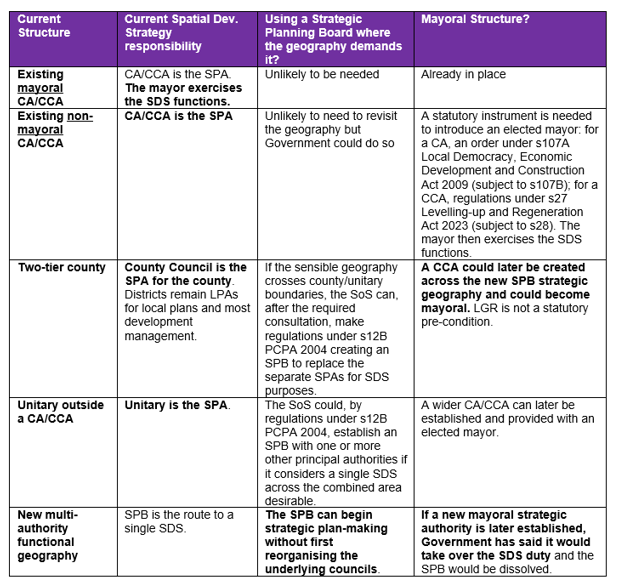
The following will be Strategic Planning Authorities once the substantive provisions of section 58(1)-(3) P&IA 2025 (the new Part 1A PCPA 2004) are brought into force by commencement regulations, regardless of the scale and pace of LGR:
- a Combined Authority or Combined County Authority (CA/CCA);
- outside a CA/CCA, an upper-tier County Council;
- a unitary authority outside a CA/CCA.
The Secretary of State can also establish a Strategic Planning Board (SPB) by regulations where one sensible strategic geography crosses two or more of those areas. The SPB then becomes the SPA.
The New Roadmap?
There are various routes to SDS adoption now, which suggests several branches rather than a single LGR-driven route. None of the routes below rely on LGR. (The Government’s February 2026 consultation on SDS geography also already anticipated SPBs being created while LGR/devolution was still moving, then being reconstituted or dissolved as the governance map changes).
Boards Set Strategy?
The February 2026 consultation noted that, where areas agreed the proposed geography and how an SPB would operate, the arrangements could be progressed quickly through secondary legislation. SPBs are now therefore likely to be an important bridge to continued progress for areas that require a new geography for strategic planning.
One of the challenges for all parties is institutional thickness. An established Combined Authority, or a long-standing joint planning arrangement, has officers, governance, (some) budget, evidence, data and habits of political working. Entirely new SPB geographies may have none of them (and still has to agree housing distribution, assemble strategic evidence, align infrastructure and transport, manage consultation, prepare the strategy and take it through examination).
There is ultimately a trade-off in terms of pace – achieving functional strategic planning geographies without waiting for LGR does not mean a functional institution or set of wider relationships. Although a statutory instrument can create a Board quickly, developing strategic planning institutions will require continued investment and, perhaps, some fiscal carrots.
A SPB could be established first and a CCA later created across the same or a similar geography and made mayoral. The CCA would then become the SPA and its SDS functions would be exercisable only by the mayor; the SPB could then be dissolved.
How much the Mayor would want to change the SDS at that point remains to be seen and represents a downside of a LGR-last sequence. So too, the scenario where a SPB exists but without the range of Mayoral delivery and infrastructure-related powers noted in my first article.
Rewiring the State
The 31 July Cabinet Statement committed to the Rewiring the State White Paper this autumn, with a clear implementation timetable, plans for legislation, alignment of public-service geographies and further devolution of powers. It was also clear the timetable itself would be informed by the need to build local delivery capacity and capability. Following the 7 September LGR review announcement, a more fundamental task has been added – explaining the role of local government in a devolved country.