


The workings of the Nature Restoration Levy are now clearer following consultation on the first Environmental Delivery Plan (EDP). The key question is whether the Levy regime can help build an effective market for ecosystem services that unlocks planning decisions and investment.
The regulator and investors have different interests, but aligned end goals:
- Natural England needs a reliable flow of Levy receipts to support the conservation measures it is expected to secure and deliver.
- Developers need a quicker, clearer and commercially workable alternative to existing project-by-project mitigation snakes and ladders.
A Levy that works, works for both of them.
Emerging Markets
Natural England will largely buy nature services from landowners, habitat banks, environmental organisations and contractors, potentially through arrangers and other intermediaries. All need a margin. The Defra statutory guidance envisages EDP payments creating sustained demand for these services.
Developers can already contract with these players directly. How does a voluntary Levy make it attractive not to do so? Unlike the Community Infrastructure Levy, the Levy has to work in a way that wins customers.
Timing matters. Conservation measures may need to be secured or started before development begins and the Levy receipts arrive. Natural England will need to fund commitments in advance, relying on later receipts to recover that funding. This is, in some ways, Tax Increment Financing….
Developers can still buy credits or commission mitigation through the conventional route instead of the Levy. If the Levy price, process or risk profile is unattractive, NE will end up without the receipts needed to repay its up front financing of ‘conservation measures’. Likewise, these measure will need to be carried out on land that is likely to be in third party ownership – the amount of Levy landowners ultimately receive will also play a role unless land rights are assembled by the state through other means.
What Does Levy Payment Buy?
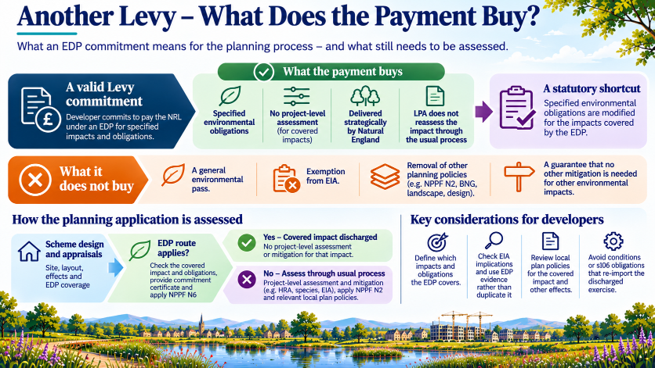
A valid Levy ‘commitment’ gives developers a statutory shortcut on specific impacts:
- It buys a statutory disregard for environmental impact of the ‘relevant development’ on:
- The protected feature (of a ‘‘European site’ or ‘Ramsar site’) identified in the EDP, for Habitats Regulations purposes only[1]SSSIs and marine conservation zones
- Protected species (or, rather, it requires the decision-maker to treat the relevant protected species licence as granted on the terms set out in the EDP).
- That only applies to the environmental impact identified in the EDP – e.g. relating to nutrient pollution, air pollution or habitat loss if that impact and protected feature are within the EDP. The Levy Charging Schedule prices the relevant impact but does not itself define the statutory exemption.
The Levy commitment is therefore intended to
- Allow development to go ahead despite an adverse impact on a designated site that would otherwise require one of the statutory derogation tests to be engaged;
- Avoids the usual project-specific Habitats Regulations:
- Appropriate Assessment
- Mitigation measures at project level
- No separate project-specific mitigation for that same covered impact.
National policy is not necessarily aligned with this: NPPF Policy N6 recognises the EDP route for relevant protected-site impacts as avoiding a reason for refusal but does not disengage the mitigation hierarchy in Policy N2 (avoidance–mitigation–compensation). Nowhere is it said that the N2 hierarchy should not apply to the impact bought out by the Levy – this is common sense and hopefully will be applied as such or reflected in the PPG.
Mind the Gap
It is important to bear in mind for assessment and PR purposes that the Levy commitment does not necessarily remove:
- The harm: the Secretary of State can only make an EDP only where its conservation measures will, by the EDP end date, ‘materially outweigh’ the negative effect of the maximum covered development on the conservation status of each identified environmental feature[2]
- All project-level assessment of that harm (see below).
Committing to the Levy therefore gives a limited pass, depending on how broad the EDP itself is:
- Statutory BNG remains a separate requirement. The Autumn Budget 2026 announced a future exemption for residential brownfield developments on sites up to 1.5 hectares; that change has not yet come into force.
- NPPF mitigation hierarchy needs to be properly applied – as above, this requires some clarity in the PPG.
- Development-plan policies still matter, particularly where they address other biodiversity, design or place-making effects. Under paragraph 2 of NPPF Annex A, parts of existing plans materially inconsistent with national decision-making policies should generally be given very limited weight, subject to the stated exception for plans adopted or made against the Framework. A policy requiring separate mitigation for the specific impact addressed through N6 and an EDP may need to be approached on that basis.
Other environmental impacts outside the environmental feature and impact identified in the EDP still need to be:
- Dealt with in line with the mitigation hierarchy;
- Assessed;
- Mitigated, where required, under relevant policy (including N2); and
- Considered by the decision-maker.
EIA is a separate boundary. A Levy commitment does not remove the physical effect of development or disapply the current EIA Regulations.
- An Environmental Statement may still need to identify and assess a likely significant effect, explaining where relevant how the EDP evidence and conservation measures actually address it;
- Where a physical effect is not addressed by the EDP, its EIA consequences still need to be assessed in the ordinary way;
- Even for a covered effect, strategic conservation measures will not always be safely be able to simply be assumed to eliminate an otherwise significant project-level effect.
Until any replacement environmental-assessment regime is brought into force, decision-makers and advisers need a clear line between the statutory impact disregarded for the specified obligation and the effects that remain relevant to EIA and planning policy. The aim should be to use EDP evidence, rather than duplicate it.
Keep It Simple
The lesson from CIL is that a reasonably low, predictable levy can work. I touched on phasing in the previous article. CIL charging challenges have been around how permissions, phases and payment triggers interact. Since the 2014 amendments (and 2019 refinements), each phase of a phased planning permission can be treated as a separate chargeable development. It remains complex, but phasing can be structured to match delivery and land disposals.
The NRL is different:
- “Relevant development” is the key unit: the development described in the request to pay accepted by Natural England.
- Liability is assumed for the whole of that development.
- Where several people assume it, they are generally jointly and severally liable.
- Liability can be transferred, but the sale of one parcel within the relevant development does not, by itself, segregate the Levy liability for that parcel.
There is more flexibility to match development programmes and disposal strategies than has been suggested in some commentaries:
- Regulation 11 allows Natural England to permit payment by instalments: separate portions of the Levy, each with its own amount and due date.
- Regulation 12(3) expressly allows a due date to be tied to an event such as commencement of a development phase.
- An instalment timetable can therefore follow build-out rather than a rigid calendar.
But a payment timetable for a whole-development liability is not the same as making each phase separately chargeable, as CIL allows. Joint and several liability applies where there is more than one liable person, but not automatically to every parcel owner. Where nobody assumes liability, Natural England must generally impose liability on owners once the statutory conditions are met. It may also do so following payment default. In those cases, liability is normally apportioned by value between material interests.
Take a 1,500-home outline scheme: there are successive reserved matters, infrastructure phases and parcel sales over ten years. If one Levy commitment covers the whole scheme (as a single ‘relevant development’), the parties need to establish at the outset:
- who assumes liability
- which phase triggers each instalment
- how transfers work
- what happens when development details change.
Regulations 11(3) and 13 allow instalment amounts, numbers and payment dates to be amended, but do not provide CIL-style automatic separation of ‘phases’.
On multi-owner schemes, a single commitment may therefore require a master-developer liability, indemnity and security structure. That adds complexity compared with simply buying off-site nutrient credits.
An alternative will be to create separate Levy ‘commitments’ for suitably defined parts of a scheme, each constituting its own ‘relevant development’. Whether that is accepted, and how the EDP capacity and pricing work, need to be resolved with Natural England. Otherwise parcel disposals may need contractual allocation, indemnities and security to manage a wider liability. Developers need the answer before settling permission structures or selling phases. That means they need to know now.
[1] Under paragraph 1 of Schedule 3 to the Planning and Infrastructure Act 2025 for the purposes of Part 6 of the Habitats Regulations 2017.
[2] section 65(3)–(5)