


My previous articles on Local Government Reorganisation and Strategic Planning have highlighted the enhanced powers for Mayors, if/when they are elected in new areas.
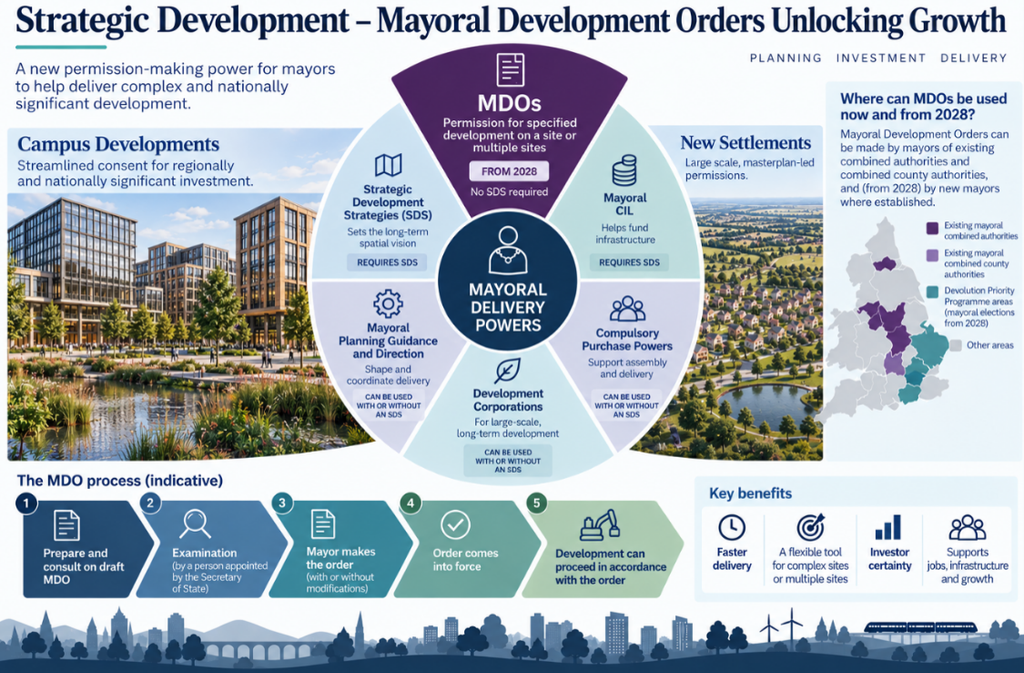
One of these powers is the ability to grant permission by a Mayoral Development Order (MDO), which is a potentially powerful tool in helping get major projects ready for investment.
The style of power is not new. The wider Special Development Order power for the Secretary of State has existed since the 1930s, allowing permission to be granted for specified development or classes of development (on specified land or descriptions of land). The MDO power has existed on paper since 2015 (in London), but the operative provisions have never been fully commenced and no MDO has therefore been made.
The English Devolution and Community Empowerment Act 2026 extends the dormant MDO power beyond London and removes key LPA gateways. Government now proposes to bring the original 2015 provisions and the 2026 amendments into force together.
You Need A Mayor…
Outside London, an MDO is only available where there is a mayoral CA or CCA (and once the MDO provisions have been commenced). A CCA can exist across a continuing two-tier local-government structure, so if new mayoral strategic authorities are created without waiting for LGR, MDOs may become a particularly important tool:
- the Mayor’s Spatial Development Strategy cannot allocate specific sites;
- an MDO provides a specifically mayoral route to reduce planning risk on a strategic site and provide a single strategic permission-making tool across a complicated local geography; but the legitimacy point sharpens too;
- Once commenced, the English Devolution regime will remove the requirement that each relevant local planning authority request the MDO, consent to consultation on it and approve the final order. It also removes the LPA approval requirement for later revision or revocation.
So What?
An MDO may grant planning permission for development specified in the order on one or more specified sites. Permission can be unconditional or subject to conditions and limitations.
Although it is not a GPDO-style power allowing a free-floating class of development to be approved across the whole mayoral area, the consultation envisages a broad consenting framework, closer in practical operation to an LDO. An MDO could establish a development envelope, parameter plans and a framework of conditions, with later certificates of conformity or condition approvals dealing with detail. The consultation points to the Gravity and Nansledan LDOs as models.
Some care is needed in treating LDOs as analogous:
- SDOs are expressly allowed[1] to grant planning permission for ‘development specified in the order or for development of any class specified’
- LDOs have the same scope for development specified or classes of development[2]
- In contrast, an MDO may only grant planning permission for ‘development specified in the order’ albeit that it can do so one or more specified sites[3]. It contains no equivalent express power to permit a ‘class of development’.
- That does not mean an MDO must describe one fully-designed scheme. The ‘specified development’ can be broad (and the ‘jelly mould’ given shape through a development envelope, parameters, uses, floorspace and other controls), with conditions dealing with later detail. Using existing Use Classes to help describe that ‘specified development’ is not the same thing as relying on an express statutory power to permit a class of development defined in the order itself.
Care will therefore be needed not to assume that the full legal flexibility of an SDO or LDO is automatically available to an MDO.
Where the form of development can be clearly specified and assessed in a coherent way, the use of single or multi-site MDOs nonetheless has huge utility for:
- Growth areas where ownership is fragmented;
- New settlements;
- Regeneration areas;
- Campuses and employment zones;
Concerns expressed about Mayoral call in of PSI applications therefore need to be balanced against the more positive use of the powers where a Mayor is in place:
- Using the SDS to identify where strategic growth should happen
- Using wider powers to align transport and infrastructure behind that
- Assembling land where necessary
- Using an MDO to make it investable
- Setting a strategic CIL if justified.
Proposed MDO Process
The consultation proposes an LDO-style procedure under secondary legislation:
| STAGE | WHAT HAPPENS |
| 1. PREPARE | Draft MDO + statement of reasons + plan + technical evidence |
| 2. ENVIRONMENTAL CHECKS | EIA screening/scoping where relevant + Environmental Statement if required + Habitats Regulations |
| 3. PUBLICISE & CONSULT | Website + site notice + land interests + LPA + statutory consultees + affected parties; minimum 30 days |
| 4. CONSIDER REPRESENTATIONS | Mayor considers responses and changes required |
| 5. MAKE THE ORDER | MDO itself grants planning permission |
| 6. IMPLEMENT | Conditions / detailed approvals / certificates of conformity; s106 can be secured where required |
| 7. REVISE OR REVOKE | Separate statutory publicity and consultation process |
The consultation does not propose a mandatory Inquiry or Hearing before an MDO is made – it sets a statutory consultation and consideration duty, rather than examination. This reflects the underlying common law controls on the exercise of such powers, which require (among other things) the decision-maker to avoid a procedure that is conspicuously unfair[4] but do not set any level or mode of engagement.
The Government intends to lay the secondary legislation and implement the MDO legal framework by the end of 2026. It has also funded the GLA to work through the technical/legal model, drawing on experience of LDOs and SDOs, with guidance and best practice to follow.
Some Challenges
- Ensuring that the form of MDOs is actually investable means:
– Where anything but a simple specified scheme of development is concerned, being very clear about what the project is, how it is defined and what the minimum requirements are
– Providing a clearly understood development specification
– Marrying up sensible and proportionate environmental assessment with a proportionate / effective set of scheme controls that do not simply kick the can down the road in a way that undermines investor confidence - MDOs are not, unlike Simplified Planning Zone, subject to a statutory ‘sunset’ time limit. They are, however, subject to an express revocation provision. That is not unlike other forms of planning permission, and compensation can be claimed where an MDO is revoked. Unlike, for example, an SDO, revocation can be done by a (new) Mayor (without, as would need to be the case for an SDO, needing Ministerial approval and Parliamentary acquiescence). In substance, this should not put off investors but it will require some consideration.
- Preparing a functioning MDO for a growth area, sitting across several sites, will require substantial planning capability in the Mayoral authority. The same new Mayoral teams may simultaneously be trying to prepare their first SDS and operate the new PSI system.
- The consultation envisages publication of the draft Order before consultation. If this is the eventual model, care will be needed about avoiding conspicuous unfairness where the Order then changes before it is made.
[1] Section 59(2)(a) TCPA 1990
[2] Section 61A(2)
[3] Section 61DA(1)
[4] See Hough [2022] EWHC 1635 (Admin) @[88]